TAL STREETER
FROM THE PLACE AT THE FAR END OF THE SKY
It might be said that there is something about the expansiveness of the sky that can effect a similar response in those attracted by its boundlessness. Tal Streeter grew up in the big sky country of Kansas and embraced this aspect of our world as a universal environment for expression. He often pointed out ‘The sky begins at our feet’. Tal’s work made the surrounding lack of scale reveal itself; the endlessness is in the American sky.
Tal established himself in New York in the 60’s as a successful minimalist sculptor working in steel , with the patronage of Leo Castelli and Ivan Karp. His most famous piece, ‘Endless Column’, a seventy foot red steel zigzag into the sky, was installed in 1970 in Manhattan, and remains today the tallest nonobjective sculpture erected in New York City.
Watching a crane lift the sculpture, it occurred to Tal that he could offer a similar experience via red lines drawn on large kites. And that an artist might additionally escape from the confines of the gallery and work on a much larger canvas.
Within days of this installation, he left for Japan with his wife and daughter to study the traditional art of Asian kite making, the first western artist to do so. He had abandoned the world of heavy metal and grinders, along with the razor honed New York art scene, for a two year period of spiritual calm, turning handmade paper and bamboo into kites. This two year retreat resulted in the seminal art kite book ‘The Art of the Japanese Kite’. I came across this book in art school in the 70’s and it had a compelling effect on my conception of kites as art.
Tal later moved to Korea as a Fulbright Professor. This began a long relationship with the country that lasted the rest of his life. Some of Tal’s largest and most significant sculptures were produced there, often enormous, powerful, elegant red steel pieces that reached into the sky or defined a relationship with the landscape. He returned to Korea many times and eventually designed his most ambitious project – a huge structure on a small Korean island, featuring a museum, and 10 story elevated platforms surrounding a 100 foot diameter tube of lasers that would project a brilliant red line five miles into the night sky from a Korean island. It would be visible from Japan. While in Korea, Tal also explored the world of Korean kites and began another collection.
Back in the US at M.I.T., where Tal was a research fellow in the Center for Advanced Visual Studies, he began an investigation into the planar elements of a sculpture which would capture in full scale a fragment of the curvature of the earth. This has been explored in several of his large sculptures, both in the US and in Asia.
One of the projects he was working on at the end of his life was an art housing for the Space Elevator competition. A brilliant red sculpture slowly traveling 65 miles into space.
Clearly, the sky has always been Tal’s element and main inspiration. For many years in Santa Fe, he photographed the sky and cloud formations several times a day. His vision moved ever upwards, seemingly without limit, and with few limitations in scale.
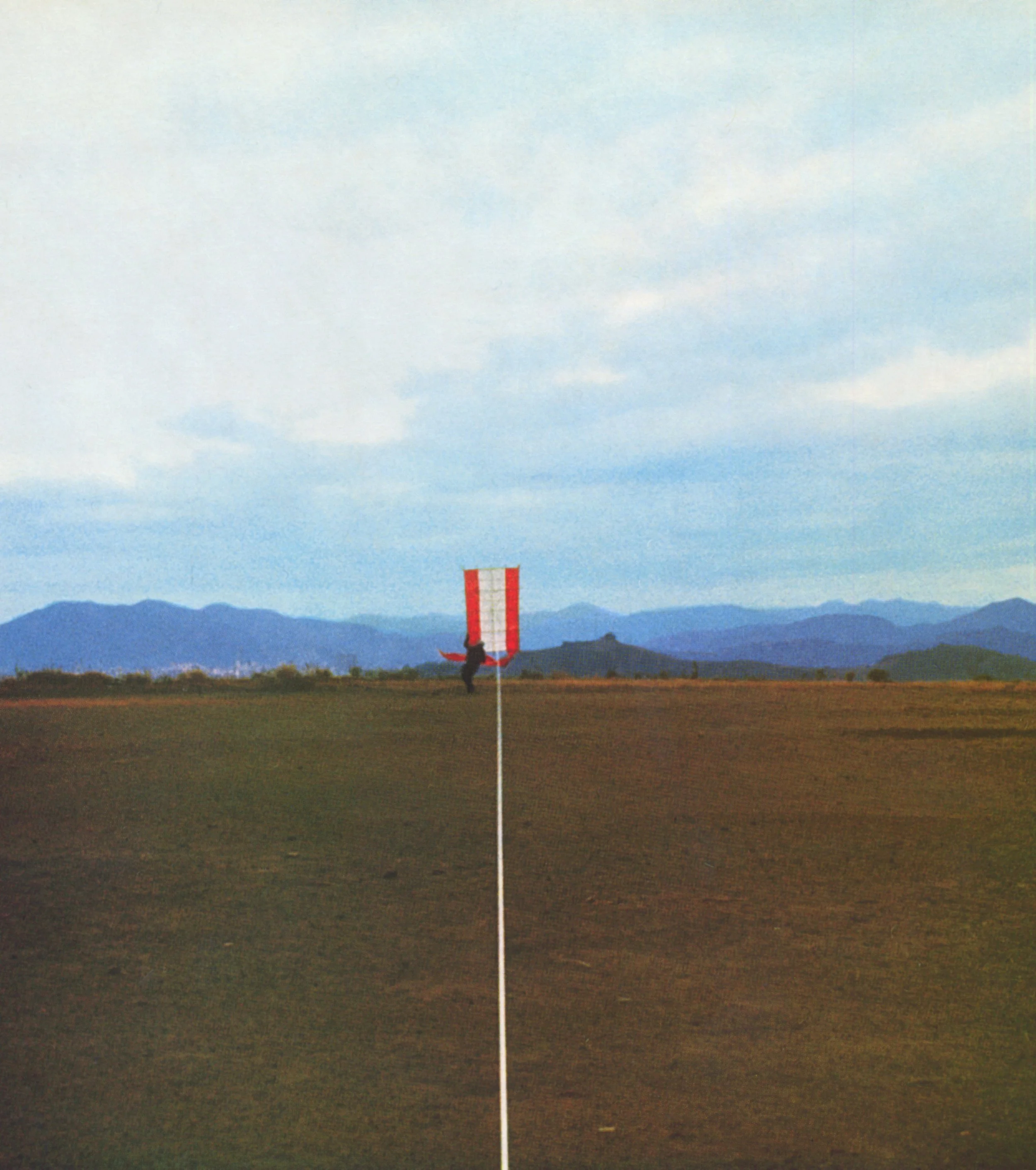
His work with kites followed the same paradigm. His series of Red Lines were exhibited throughout the US and in Japan. Color studies for this series are in the Museum of Modern Art. His Albers Dream series investigated the phenomenon of a carefully framed open space in a kite appearing darker than the surrounding sky. The Flying Red Line is a 400 sq ft. red parafoil with a triangular apron sloping to a one foot wide red tail that is five miles long. We have flown it a number of times, usually over dry lakes in the desert, not without difficulty. His concept was a single red brushstroke, extending beyond the range of human vision, streaking across the sky and ending in a brilliant burst of color overhead.
Tal was probably the most famous artist who used his talent in the world of kites. He worked closely with a number of major artists in the field of Sky Art including Otto Piene, Jackie Matisse, Curt Asker and others. Uniquely among kitemakers, Tal’s greatest contribution to the art of kites was his writings.
The ‘Art of the Japanese Kite’, opened Western eyes to the qualities of Japanese kites – published before Pelham. ‘Art that Flies’ marked a set of collaborations with other artists that culminated in the Kite Art Volante Manifesto in the 90’s that outlined the intentions and spirit of several serious artists. His books and essays feature a remarkable style of personal reflection , delivered with a combination of childlike wonder, wry humour, and the perspective of vast experience in the international art world. A number of other books, published and some unfinished, examined kites and their effect on our lives, in India, Korea, Europe, and the US. He had just completed a biography of Domina Jalbert when he passed away in 2012. He is survived by his wife, the potter Romig, and his daughter Lissa, a food stylist in Paris.
-DAVID WAGNER